An accountability partner is a person who agrees to check whether you did the thing you said you would do. That is the whole definition. Mutual or one-way, a standing Sunday call or a text at 7am, and the goal can be a gym target or a thesis chapter nobody but you will read.
The job itself is small. Notice when you show up. Notice when you don't. Say something either way.
That last part is the load-bearing bit. Most goals die in private, with nobody in the room when it happens. An accountability partner drags it into the open, where skipping costs something and finishing pays something.
The setup is older than self-help books. Sponsors in Alcoholics Anonymous, training partners in boxing gyms, study buddies in libraries. Same shape. Different room.
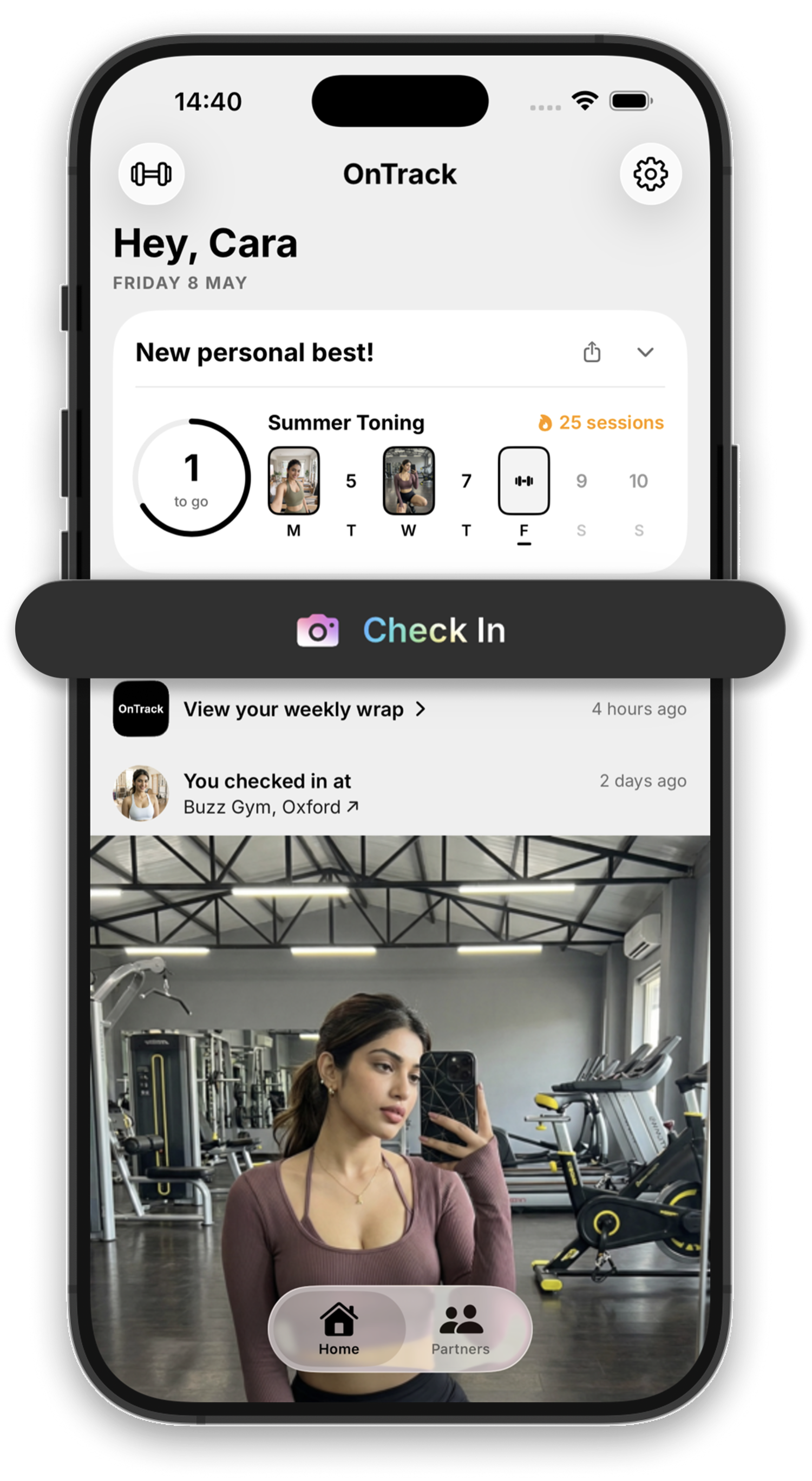
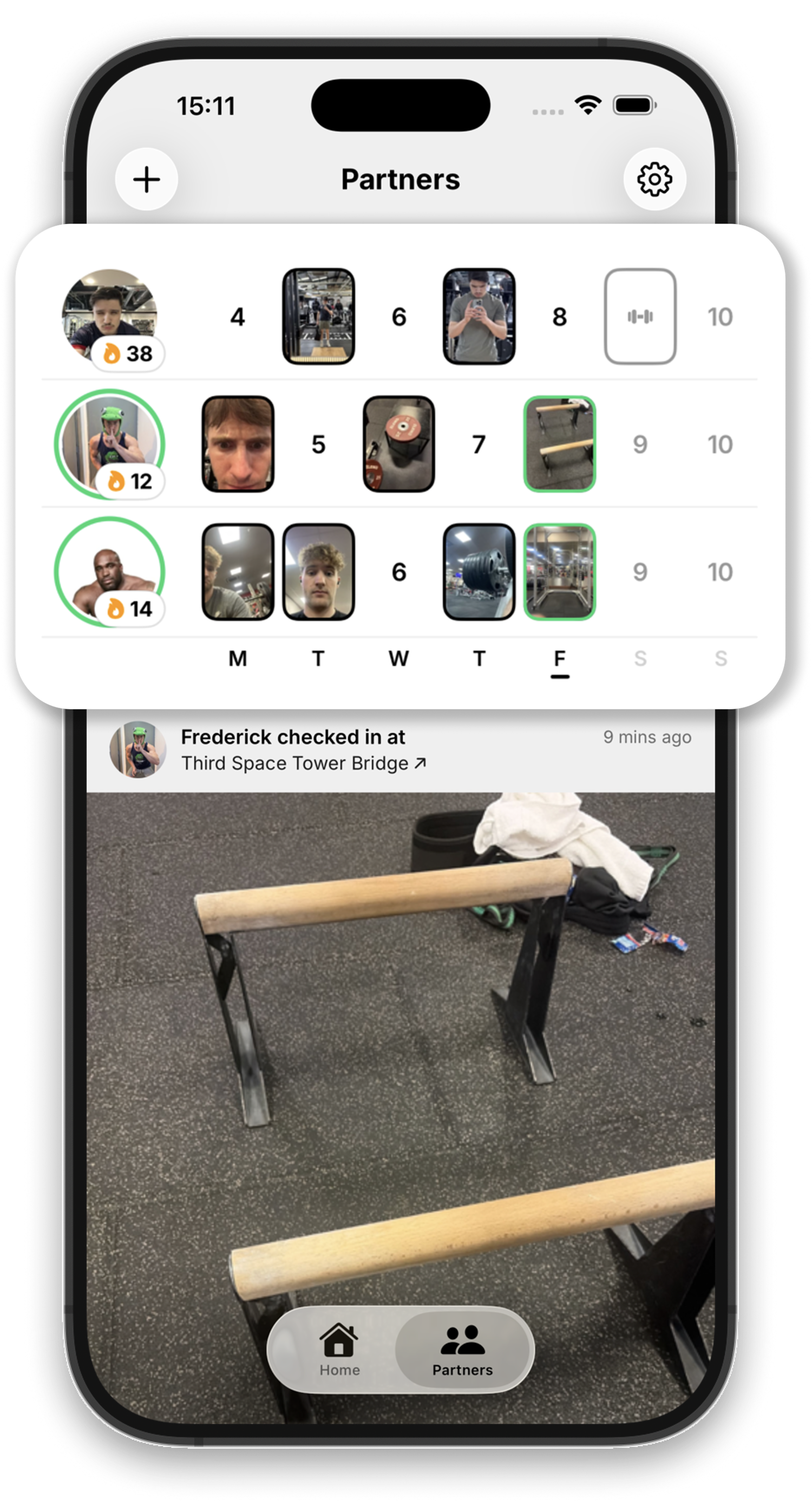
OnTrack is a free app that does the noticing for you, on iPhone and on Android. Your partners see every check-in land: a live photo, the time, the name of the place you were standing in. They get told when your streak breaks, too.


The five common types.
Gym or fitness. The classic. Two people agree to train on a schedule and send proof. Notice what the partner is looking at: whether you went, not whether you lifted heavier. Showing up is the whole job.
Business or work. A peer at your level. Weekly call, you name three things you'll ship by Friday, they name theirs, next Friday you compare. The good ones don't coach. They just remember what you said.
Recovery or sobriety. The deepest version, and the template the rest borrowed from. Sponsors in twelve-step programs run a real protocol: daily contact, real stakes, a structure built to survive a relapse.
Study. School, university, anywhere with a library. Two students keep each other to a study plan. 9am, phones face down. Sometimes the partner is only a body in the next chair, and that is plenty.
Romantic. Couples try it for money, food, or bedtimes. The hardest one to run, because nobody wants their partner doubling as their supervisor. Small goal, specific check-in, or leave it alone.
The rest of this is about the gym version, which is the one OnTrack exists for. Most of it travels fine to the other four.
What a gym accountability partner actually does.
Not much, and that is the point.
They know which days you train. Not three or four a week. Monday, Wednesday, Saturday, named out loud, so a missed Wednesday is a specific missing thing rather than a vague sense that the week got away.
They see the proof. A photo, a time, a place. Not a text saying you went.
They notice the silence. You go quiet on Wednesday, you're still quiet on Thursday, and something arrives at 8pm, badly spelled, and you put your shoes on.
The number behind all of this.
The American Society of Training and Development looked at how likely people are to hit a goal, based on the kind of accountability they had.
Source: American Society of Training and Development
Telling a friend more than doubles what deciding alone gets you. A scheduled check-in, where one specific person is expecting to hear from you on a particular day, takes it to 95%.
How to be a good accountability partner.
The job is mostly restraint.
Don't preach. Your friend knows they skipped and does not need reminding that they are failing themselves. They need reminding that the streak is one session from being fine.
Don't disappear. Stop reacting to their check-ins and they stop sending them, faster than you would think. A thumbs-up takes a second. A comment takes ten. Do it.
Don't compete. Their week and your week are not the same week. They might be sick, on the road, on a double shift. Compare them to their last month, not your last week.
Don't fudge. If you let a coffee shop selfie count as a gym check-in, you are not their accountability partner. You are their alibi.
Two things end most of these arrangements anyway. The first is when you both drop off in the same week. Nobody left to notice the silence, and the streak dies without a funeral. The second is when one of you turns into the manager and the other into the employee, and the whole thing starts to feel like a job neither of you applied for.
The fix for both is the same. Put something small and neutral in the middle to do the noticing, so neither of you has to play boss. A shared spreadsheet will do. So will a group chat with a strict format. Or something built for the job.
OnTrack only ever opens the live camera, and it reads your GPS at the instant of the shutter. The location is verified, not typed: you choose from the places that were actually around you, so a check-in can only ever say where you really were. Which is the point, when the people reading it know you train on Wednesdays.
The longer version of why this works at the gym is over here: You're not lazy. You're alone.
What to try this week.
Pick the smallest possible setup.
- Pick one person. Not five. One person you would be mildly embarrassed to flake on.
- Name the days, not the number. Three a week is a wish. Monday, Wednesday, Saturday is a plan.
- Pick a proof format. A photo with a time and a place on it. Nothing that can be sent from bed.
- Agree now what a miss costs. Decide while you are both keen, not on the Thursday you are arguing.
- Don't try to be a coach. Notice, don't manage.
The bottom line.
An accountability partner is the smallest piece of social pressure you can bolt onto a personal goal. That is all. It works because we are bad at keeping promises to ourselves and surprisingly good at keeping them to one person who is paying attention.
Pick the person. Name the days. Send the proof.
A definition you can install.
OnTrack gives an accountability partner something to look at. Send them a link, name the days you train, then check in from the gym floor: live camera, GPS-verified location, coordinates locked the moment you take the shot. They see it land, and they see it when it stops.
Completely free. No paywall, no subscription.
Read next