It's a Sunday night. You've cleared out the kitchen, you've made a list, you've watched a video about meal prep. You feel ready. Tomorrow is the day.
By Wednesday lunchtime you're eating whatever was left in the office kitchen and telling yourself you'll start again on Monday.
You've done this loop before. Twice, maybe five times. Calorie apps, step counters, a smart scale that syncs to a chart nobody has looked at twice. You know the rules. None of it stuck.
You are not lazy. You are not weak. You are alone.
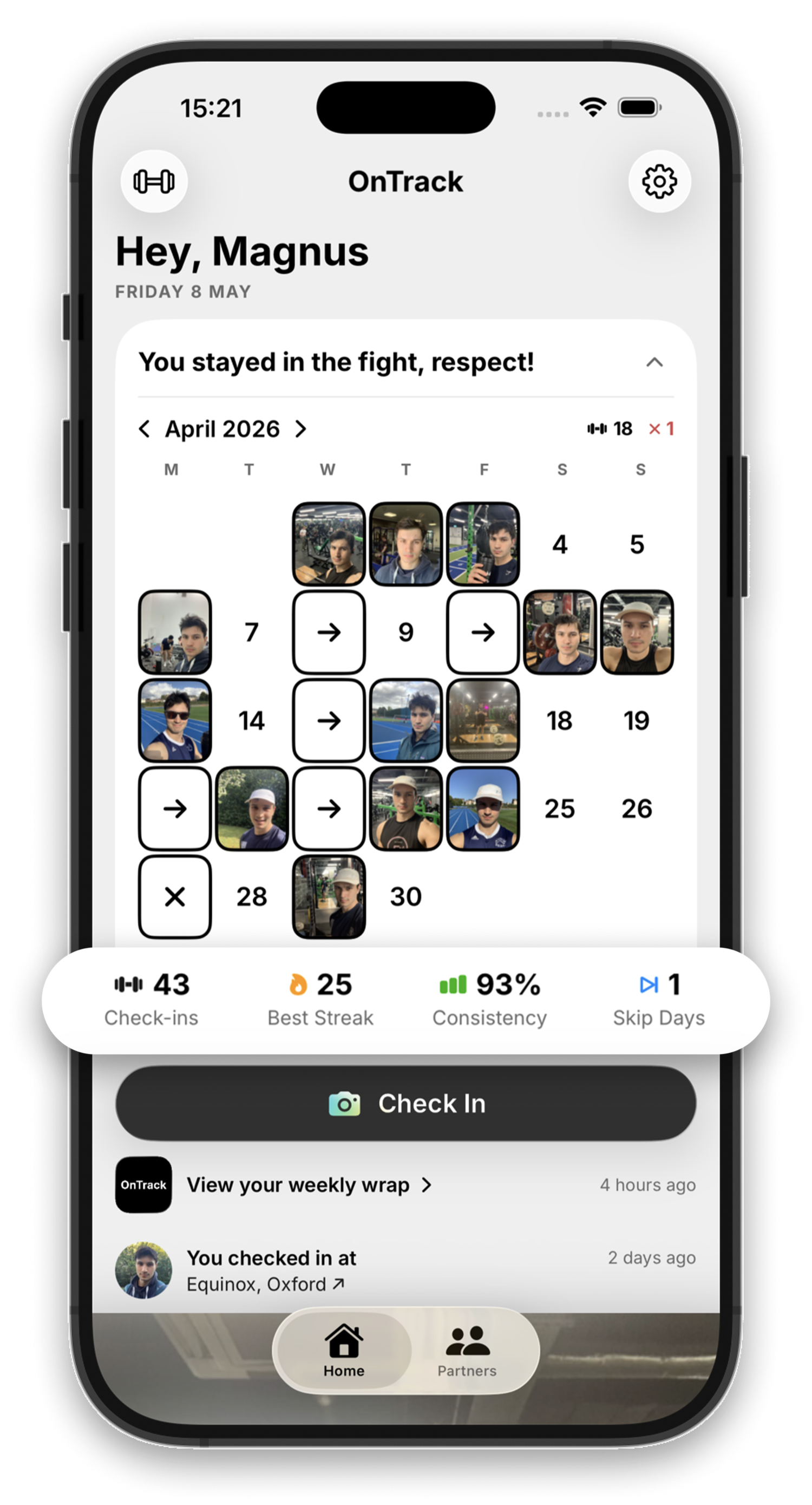
OnTrack is a free app for iPhone and Android that adds the missing piece: friends who can see whether you actually showed up this week.


You already know what to do.
You've read the headlines a hundred times. Understanding was never the hard part.
The hard part is doing it every week, for months, while absolutely nobody notices whether you do or you don't.
Which is where the tools you already have run out of road. A calorie app counts what you ate and has no opinion on whether you trained at lunch. A scale hands you a number and goes quiet. Neither one texts you on a Tuesday to ask how it's going.
The scale is the wrong thing to watch.
Not forever. Just week to week. You can't control what it says on Tuesday morning, and it moves around for reasons that have nothing to do with the week you just had.
What you can control is whether you turned up. Three sessions is a fact. It happened or it didn't, and unlike the scale, somebody else can see it. A friend can't witness your body. A friend can absolutely witness a Tuesday you didn't train.
Source: American Society of Training and Development
Decide on your own and you're at 25%. Tell a friend, 65%. Commit to a weekly check-in with that friend and you're at 95%.
So we built the app around the week rather than the day. Every Monday a Weekly Wrap lands in your feed: sessions done, where the streak sits, what your partners have been up to, and how the week compared against your last four. A flat week on that chart is a shrug. A flat Tuesday morning on the scale ruins breakfast.
Be honest. This isn't a wishlist.
That sentence is real. It's the subtitle under the first question OnTrack asks you, which is how often you'll work out. There's a slider, one day to seven, and that line sitting underneath it like a raised eyebrow.
Sunday-night you wants to pick six. Sunday-night you is not the person who has to get up on Thursday.
Pick three. Then you name the actual days, and those days become the week you're measured against. Change your mind later and the new schedule starts the following Monday, not this second, so you can't quietly shuffle Wednesday over to Saturday at 9pm on Wednesday to make a bad week look like a good one. The app will not let you launder a week.
A week with some give in it.
Most streak apps are brittle. Miss one day, lose everything, delete the app by Friday.
A streak here counts sessions, not perfect days, and it settles up at the end of the week. Miss Wednesday, train on Saturday instead, and the extra session covers the miss one for one. The week you're currently in can never break your streak while you're still standing in it.
When something real comes up there are two doors. A Skip Request asks your partners to excuse one scheduled day. They get 24 hours, and everyone you asked has to say yes. One no and the day stays on your card.
The second door is Holidays, and nobody has to approve that one. Take the week. What we're trying to stop is the quiet three-month fade, not a week you spent somewhere else, so you set a date range, anything from two days to sixty, and those days come off your target.
What your partner actually sees.
Here's where ordinary accountability falls over. You say you went. Nobody can tell.
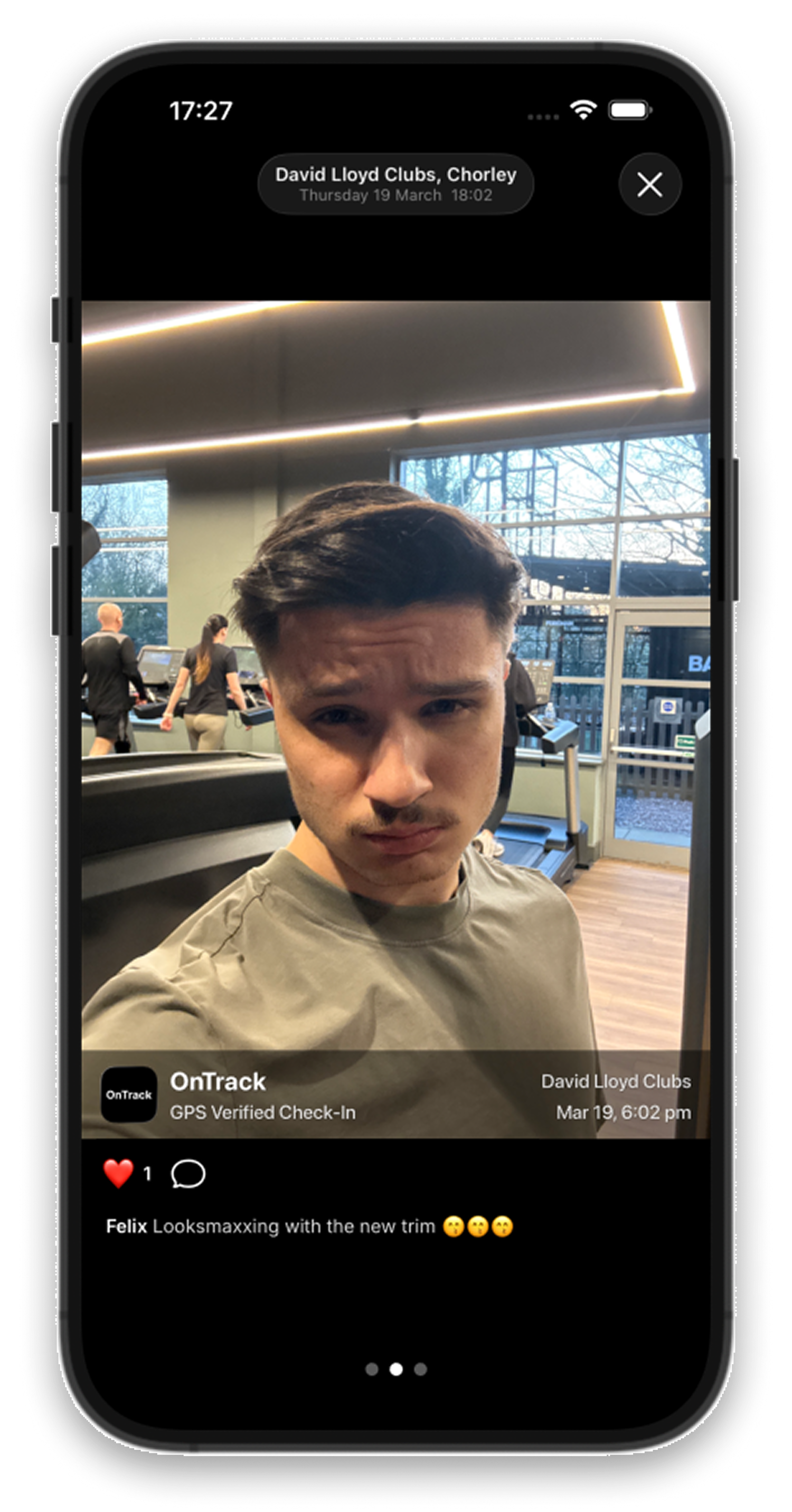
So the check-in runs through the camera inside the app, both lenses at once by default, the room you're standing in and your face in the same post, with a caption you can't skip. The GPS reading is taken at the shutter and can never be changed, and the picker only ever offers places that were genuinely near it, so the location is verified rather than claimed.
Your check-in carries a GPS-verified place, a time and your face, and every partner you invited sees all three. What that changes is the cost of skipping quietly. There is no way to type in a gym you were nowhere near.
Your check-ins are visible to you and the partners you added, and nobody else. There's no public feed to perform for, which matters more than usual at the start, when you don't much feel like being seen by anyone.
What to do this week.
You don't need another tracker. You need a number and somebody who can see it.
- Put the scale on a schedule. Once a week, same morning. Tuesday's reading is not a verdict on Monday's work.
- Keep the calorie app, demote it. It logs what you ate. It has never once noticed a session you skipped.
- Choose a number of days you'd still choose on a Thursday. Three is almost always enough. Five is usually too many.
- Send the invite link tonight. Nothing changes until somebody is watching, and the link takes ten seconds.
- Read Monday's wrap against the four-week line. One flat week is noise. Four of them is information you can use.
The bottom line.
Doing the same small thing week after week is much harder on your own than it is with one honest friend, and it always will be. Nothing about that changes when you find a better app to log it in.
Keep your calorie app if it helps you. OnTrack doesn't do food and it doesn't do the scale. It does the bit in the middle, the bit where you either went or you didn't, and it makes sure somebody else knows which one it was.
The scale can wait. Monday can't.
Set your days, send one invite link, and check in when you get there. Your partners see the receipt, and on Monday you see the trend.
Completely free. No paywall, no subscription.
Read next